
This post draws on “What to Do if Opposing Counsel Inappropriately Uses Artificial Intelligence in Pleadings?” by Karen K. Karabinos of Burke Moore Law Group, published in Georgia Defense Lawyer, Winter 2026.
The Short Answer: Courts are sanctioning lawyers who file AI fake citations, and a 2025 Georgia federal case shows how fast the penalties add up. For clients, the takeaway is to work with counsel that verifies every citation and supervises AI at each stage of litigation or recovery.
Generative AI is now part of everyday legal work, and so are its mistakes. Judges across the United States are finding fictitious cases, fake quotes, and misrepresented case law in court filings, and they are responding with show cause orders and sanctions. That matters to clients because the firm handling your cases decides how your matters get researched, drafted, and filed. Here is what happened in one Georgia federal case, what the bar now expects, and what clients should ask before handing a matter to any firm.
What “AI Fake Citations” Actually Means
Generative artificial intelligence tools predict likely text. They do not check if a case exists. When a lawyer asks an AI tool for legal research and files the output without verifying it, the result can include:
- A nonexistent case with a realistic name and citation
- A real case attributed to the wrong name or the wrong court
- A fake quote inserted into a real opinion
- A legal argument that directly contradicts current law
Legal researcher Damien Charlotin tracks these decisions in a public AI Hallucination Cases Database. As of late September 2026 it lists more than 2,000 judicial decisions worldwide, roughly 1,400 of them in the United States and more than 800 involving lawyers rather than self-represented litigants. Fabricated case law is the largest category.
A Georgia Federal Case, Step by Step
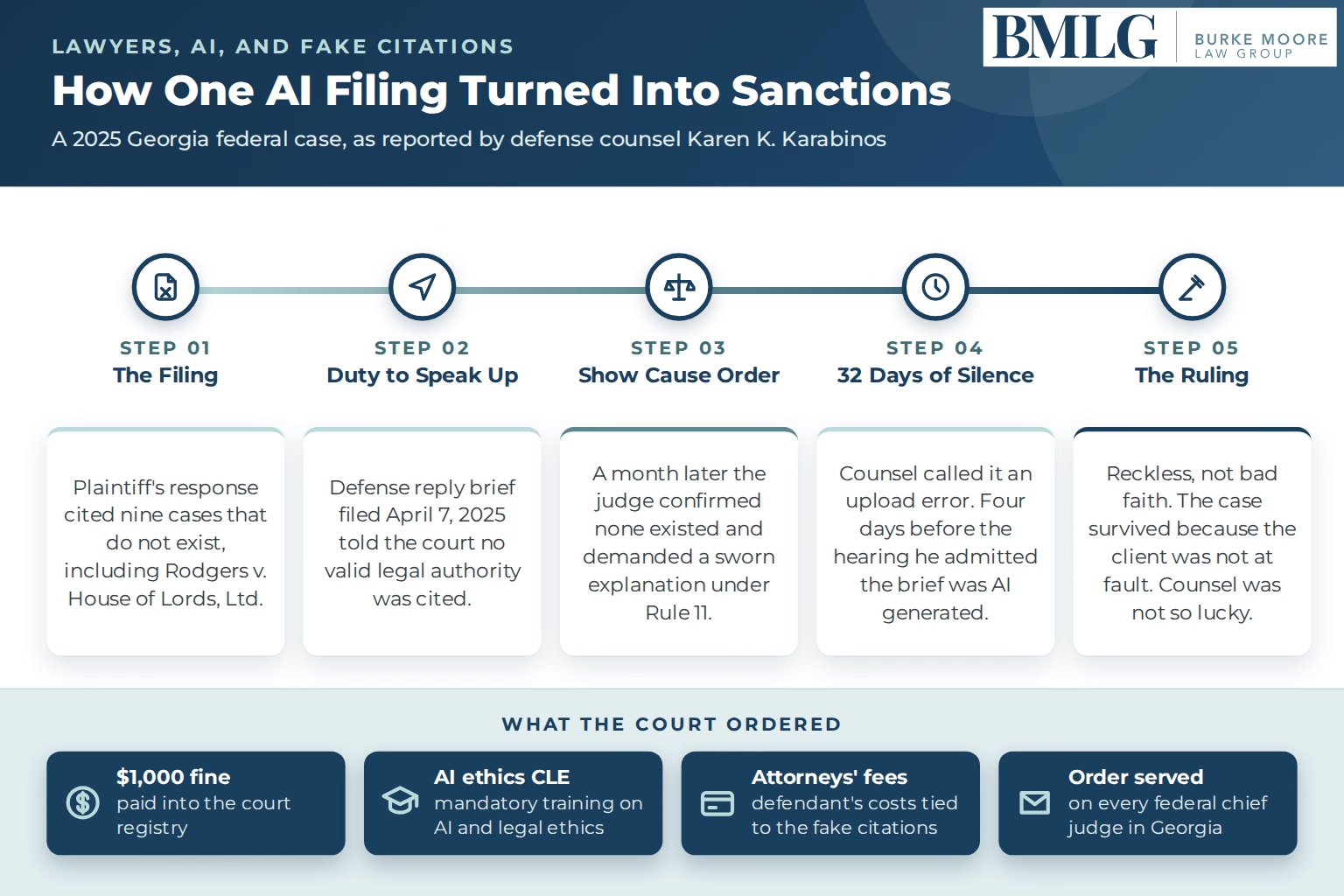
The Karabinos article describes a matter her defense team handled in federal court in Georgia. The defense had moved to dismiss the complaint. Plaintiff’s counsel filed a response in opposition, and the associate on the defense team could not locate any of the cases it cited.
What the defense found
Nine cited cases could not be located anywhere, including Strickland v. Fogler, Giles v. State Farm Mutual Insurance, and Rodgers v. House of Lords, Ltd. Some case citations pointed to real opinions under different names. Others pointed to the middle of other cases filed under different names. Two statutes were cited for propositions they did not support.
The lawyer’s duty to speak up
Facing new territory, the team consulted their firm’s general counsel and concluded that Georgia’s Rules of Professional Conduct, which give attorneys special responsibility for the quality of justice, created a duty to alert the court. Their reply brief, filed April 7, 2025, stated that plaintiff had failed to provide any valid legal authority and that the cited assertions in most instances contradicted current Georgia law.
How the court responded
| Stage | What happened |
| Show cause order | A month later the federal judge agreed that none of the cited cases existed and ordered plaintiff’s counsel to produce accurate copies or show cause why he should not be sanctioned under Fed. R. Civ. P. 11(b) and (c) and 28 U.S.C. § 1927. The judge required a sworn declaration explaining how the response and the nonexistent cases were generated. |
| The evasive reply | Counsel did not file the sworn declaration. He filed a “response” claiming an incorrect version had been inadvertently uploaded and asked to substitute a corrected one. |
| The court’s findings | The court found the reply was not sworn and did not explain how the filing was generated. It also noted the false citations were flagged on April 7 and went unaddressed for 32 days, which suggested counsel had intended to file that version all along. Karabinos’s team also noted the “incorrect” document had been filed three separate times before the show cause order. |
| The hearing | Four days before the show cause hearing, counsel filed a sworn declaration admitting the response was generated with AI and was meant only as a framework. At the hearing he apologized and testified that a staff member made the incorrect filing. |
| The ruling | The court accepted the apology but found the use of fictitious citations and the evasive initial response forced an unnecessary hearing and unnecessary expense. It held the conduct was reckless rather than in bad faith and declined to dismiss the case, since the client was not responsible for counsel’s failure. |
The sanctions
The court ordered three things. Counsel and his firm paid $1,000 into the registry of the Clerk of Court. Counsel had to attend an approved CLE course on AI covering the ethical and legal obligations of lawyers and parties. Counsel and his firm had to pay the defendant’s reasonable attorneys’ fees and costs for researching and replying to the fake case citations and for attending the show cause hearing.
Because plaintiff’s counsel and his firm handle similar litigation across the state, the court also ordered the sanction order served on the chief judge of every federal district court in Georgia.
What Other Courts Have Done
Karabinos reports that her firm’s review of hallucinated citation cases nationwide found a wide range of outcomes:
- Payments into court registries as low as $100 and as high as $15,000
- One order to reimburse $26,100 in special master costs plus $5,000 in attorney’s fees
- One court striking the appellant’s brief and dismissing the appeal
- One attorney suspended from the practice of law
- Orders to complete continuing legal education on AI and legal ethics
The pattern is consistent. The fake citation itself is the start of the problem, and how the lawyer responds once it is discovered decides how bad the sanction gets.
What the Legal Profession Now Expects
In July 2024 the American Bar Association issued Formal Opinion 512, its first formal opinion on generative AI tools. It applies the existing Model Rules to AI and covers competent representation, confidentiality, candor toward the tribunal, supervision of junior lawyers and staff, and reasonable fees. Many state bars and courts now require disclosure or certification when AI helps prepare a court document. Our earlier post on AI policies for law firms covers that shift in detail. A firm without written AI standards is creating liability for itself and its clients.
What This Means for Clients
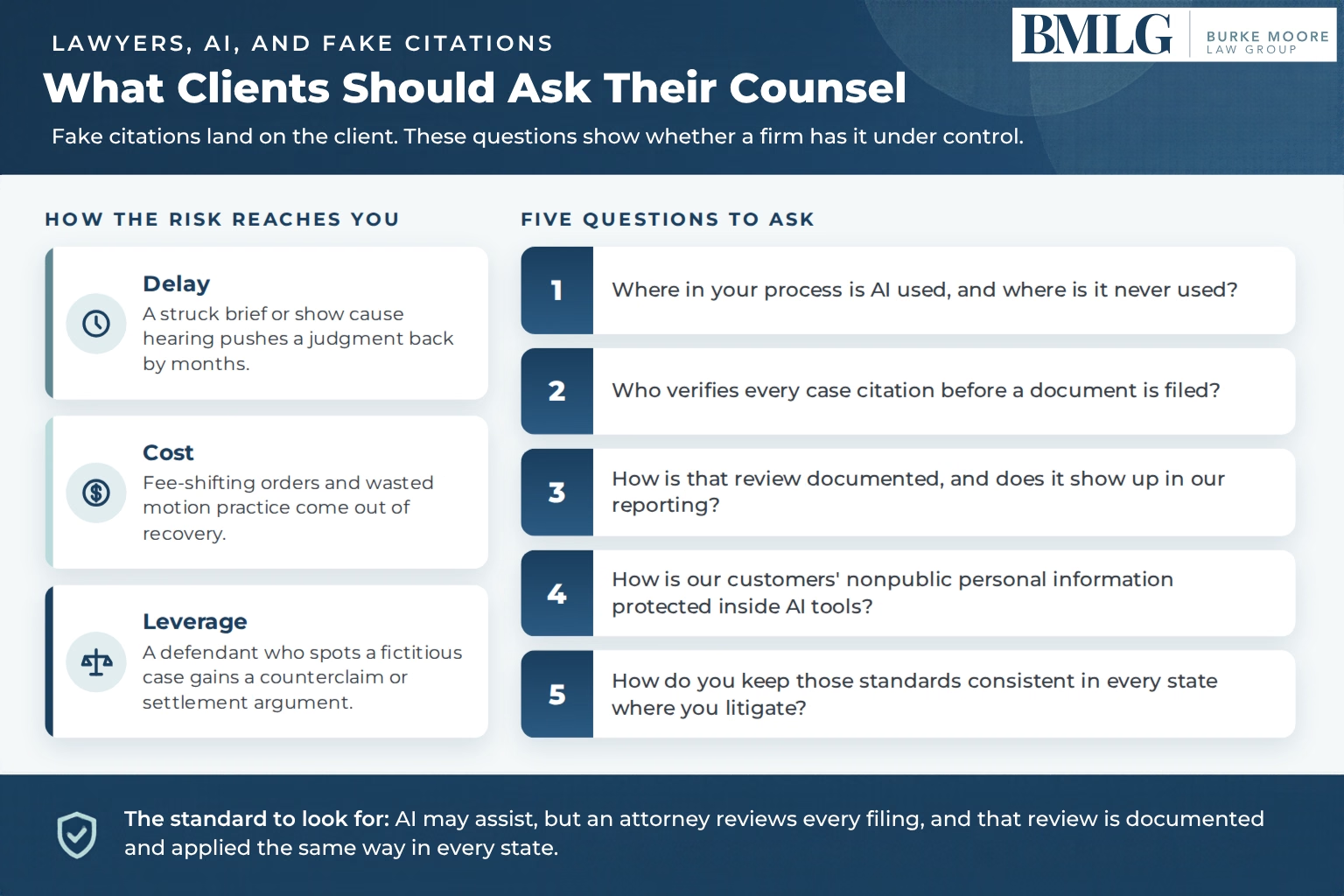
High-volume litigation, in both recovery and defense, is exactly where the temptation to let an AI tool draft filings unchecked is strongest. The risks land on the client in three ways.
| Risk | How it shows up |
| Delay | A struck brief or a show cause hearing pushes back a judgment by months |
| Cost | Fee-shifting orders and wasted motion practice come out of recovery |
| Leverage | A defendant who finds a fictitious case in your counsel’s filing gains a counterclaim or settlement argument |
Questions to ask your counsel
- Where in your process is AI used, and where is it never used?
- Who verifies every case citation before a legal document is filed?
- How is that review documented, and does it show up in our reporting?
- How do you keep those standards consistent across every state where you litigate?
How Burke Moore Handles It Nationwide
Burke Moore Law Group litigates nationwide, with attorneys licensed in the states where clients carry the highest volume. In states without a permanent office, the firm uses reciprocity rules, pro hac vice admission, or designated local attorneys who follow BMLG’s standard practices. Because the firm handles both the pre-legal and legal side under one roof, the same attorney-led review applies in all states.
The BMLG team applies legal project management and Six Sigma process methods to every matter, and the firm’s compliance program governs how technology gets used. You can read more about the firm’s approach on the About Our Firm page and review its disclosures directly.
AI Cuts Both Ways

Consumers and credit union members use the same generative AI tools to draft disputes, research their rights, and answer lawsuits. Expect more regulatory complaints and validation requests, more counterclaims and responsive litigants, and more active motion practice, including summary judgment fights that used to be rare in collection cases. Prepared clients build protocols for that volume, address defense claims in representation agreements up front, and hire counsel that is adept at defense work. BMLG’s general liability and defense and insurance coverage practices exist partly for this reason.
Final Thoughts
The Georgia case in the Karabinos article is a clear warning. A lawyer filed AI-generated citations to cases that did not exist, delayed owning the error for more than a month, and ended up paying a registry fine, attending AI ethics training, covering the other side’s attorneys’ fees, and having the sanction order sent to every federal chief judge in the state. The court pointed to the 32-day delay as evidence the filing was intentional. For clients, the lesson is simple. Ask your counsel who checks the citations, how it is documented, and how that standard holds in every state where your matters or cases sit.
Burke Moore Law Group pairs technology with attorney-led review across bankruptcy, claims recovery, debt collection, foreclosure, SBA collection, and general liability and defense matters nationwide. Contact us to discuss a recovery or defense strategy built on attorney-led expertise, call 877-219-5222, or sign up for our newsletter for more updates.